ASCENDA PEPTIDES®
Architectures of Metabolic Intelligence & Cellular Longevity
Ascenda NanoMatrix™
For decades, peptide research has relied on a legacy substrate:
Bacteriostatic water “BAC” preserved with benzyl alcohol.
It was never engineered for the modern era of Peptide science.
BAC is neither wound healing or biofilm reducing
The NanoMatrix™ Advantage
Ascenda replaces this obsolete standard with something fundamentally different.
What Makes NanoMatrix™ Different?
What Makes NanoMatrix™ Different?
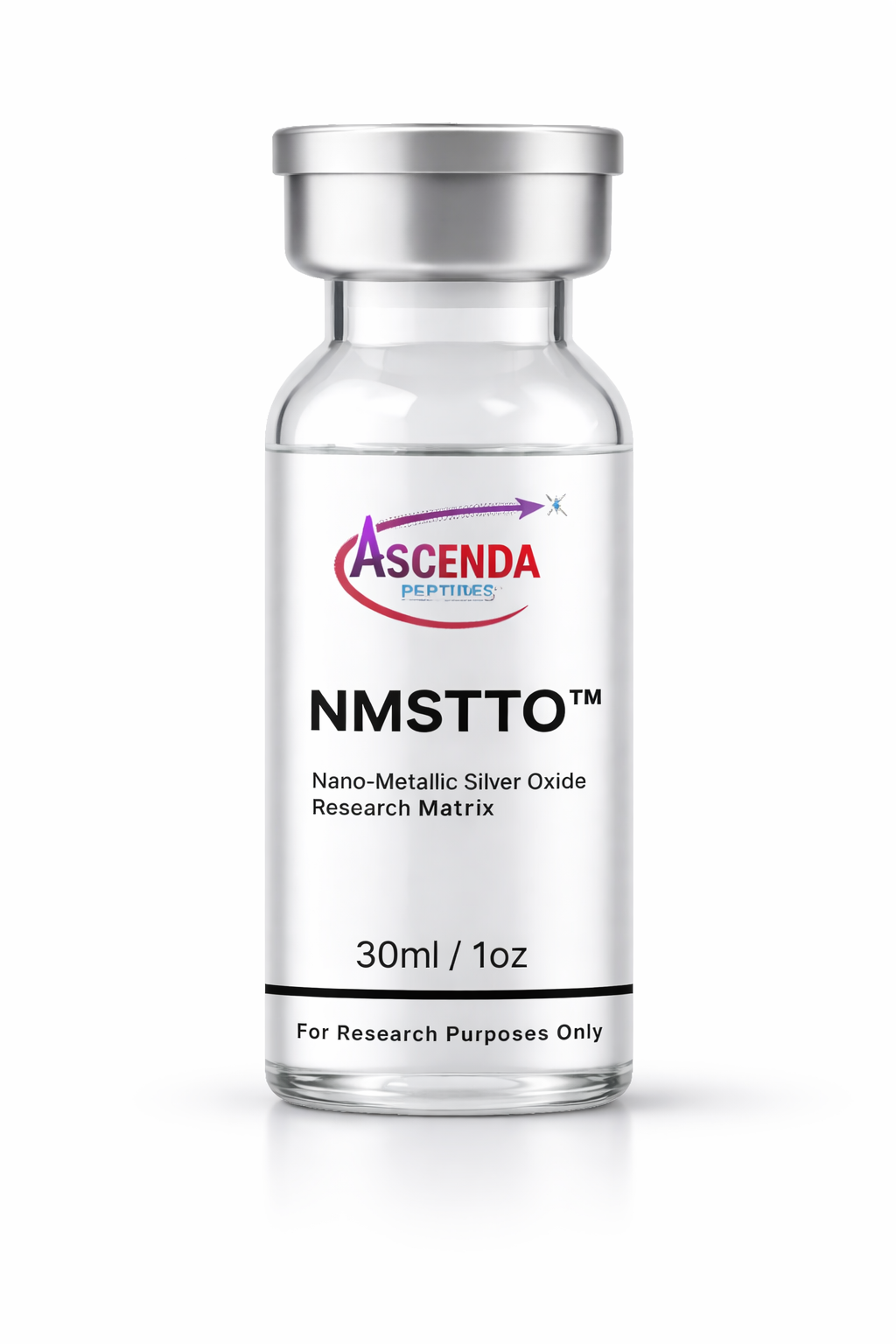
- The NMSTTO™ Nano-Metallic Silver Oxide Research Matrix is not just a diluent solution it is a biological environment
- Meets the USP standard for antimicrobial preservatives under 21 CFR Part 56 and Part 58.
- Remains safe for human ingestion.
- Engineered at the nanoscale to create a hostile environment for microbial life.
- Chemically inert to peptide structures and human tissue.
- Helps stabilize and preserve peptides after reconstitution.
- Establishes a persistent antimicrobial field through stabilized nano-metallic silver oxide particles rather than relying on alcohol toxicity.
Before Peptides can optimize biology, the medium that carries them must be optimized.
Bacteriostatic water was designed for a different era –
when:
- Compounds were inexpensive
- Vials were single use
- Cycles were short
- Contamination risk was tolerated
Modern peptide research no longer fits that model.
Today’s reality:
- Vials are accessed repeatedly (multiple withdrawls) increasing the risk of cross contamination & bacterial degradation of the Peptides
- Protocols span weeks or months
- Compounds carry high scientific and economic value
- Environmental exposure is unavoidable
- Microbial contamination increases with each draw and accelerates over time

Benzyl alcohol does not solve these
problems.
It only delays them.
- It is volatile.
- It is not wound healing.
- It evaporates.
- It introduces cytotoxic solvents.
- It does not prevent biofilm formation.
- It does not protect peptide conformation.
It is a patch, not a system.
The Ascenda NanoMatrix™ is engineered for how
research actually happens.
Engineering Sterility with Gamma
The NMSTTO Matrix is built on a Nano dispersed metallic oxide architecture.
At the nanoscale, silver oxide expresses unique surface energies that disrupt microbial membranes, inhibit replication, and prevent biofilm formation without reacting with Peptide chains.
This is not disinfection.
It is environmental control.
The NanoMatrix™:
- Maintains continuous antimicrobial activity
- As a USP 51 Preservative it does not denature
- Introduces no alcohol based toxicity
- Remains chemically inert to peptides
- Preserves molecular folding and integrity
- Prevents bacterial colonization from ever establishing
Where Bacteriostatic water reacts episodically,
the NanoMatrix operat
Where alcohol kills on contact, the Matrix engineers a terrain in which
contamination cannot survive.
This is the difference between designing something that is simply Bacteriostatic (like BAC) and the NanoMatrix™ which is designed to be:
- Both broadly Antimicrobial and Wound Healing
- Provide increased shelf life and stability of the reconstituted Peptides
- More resistant to temperature fluctuations - does not need to be refrigerated.
- Synergistic and potentiating with a variety of different Peptides.
This is a Paradigm Shift for the entire Peptide Industry
Peptides are precision instruments and their power lies in structural fidelity.
Every exposure event—every draw, every temperature shift, every microbe introduced—erodes that precision.
In conventional systems:
- Researchers accept degradation
- Protocols shorten to compensate
- Potency drifts over time
- Risk becomes normalized
The Ascenda NanoMatrix™ eliminates this compromise by
delivering:
- Continuous antimicrobial protection (USP-51 validated)
- Elimination of benzyl alcohol dependency
- Dramatic reduction in bacterial and fungal proliferation
- Preservation of peptide structure and bioactivity
- Extended functional lifespan after reconstitution
- A new safety and integrity standard for multi-draw protocols
- Improved rates of both Wound Heling and Wound Closure* Pub Med link

The Ascend Standard
Going Forward:
- Ascenda Peptides are designed to operate synergistically within the NanoMatrix
- Ascenda protocols assume NanoMatrix™ based reconstitution
- Ascenda clinics adopt it as the default substrate
- Ascenda becomes synonymous with next-generation peptide architecture
The NanoMatrix™ is not an accessory….
NMSTTO is the primary operating layer of
the Ascenda ecosystem.
Every compound that follows in this Codex is
elevated by it.
Every protocol assumes it.
Every system depends on it.
This is the new foundation.

This is not incremental improvement.
The NanoMatrix™ is a disruptive incremental improvement.
The peptide industry has been primarily focused on the Peptide molecule. Ascenda focuses on BOTH the Peptide molecules AND their carrier system (the diluent).
Every Peptide is only as reliable as the environment it inhabits.
The NMSTTO Matrix reframes reconstitution as a biological engineering problem, not a convenience step. It creates a controlled micro-ecology in which Peptides can exist with more stability, efficacy, performance and without degradation pressures from bacteria,
yeast, mold etc.
This is how an industry matures…
Not by adding more compounds but by upgrading the infrastructure beneath them.
The Value Added Benefits of the Ascenda NanoMatrix™
The Ascenda NanoMatrix™ redefines peptide reconstitution by transforming the carrier environment itself. Rather
than accepting degradation as inevitable, the NanoMatrix establishes a controlled, antimicrobial micro-ecology
that preserves peptide integrity, performance, and safety over time.
Key Advantages
1. Enhanced Stability of Reconstituted Peptides
Reconstituted peptides demonstrate significantly prolonged stability due to the inclusion of an all-natural, USP-51 validated antimicrobial preservative, reducing degradation pressure from bacteria, yeast, and mold.
2. Reduced Bacterial Degradation
The NanoMatrix™ dramatically decreases bacterial and fungal proliferation within reconstituted peptide solutions, preserving molecular structure and biological activity over extended use periods.
3. Lower Risk of Cross-Contamination
By maintaining continuous antimicrobial protection, the NanoMatrix™ substantially reduces the risk of cross-contamination associated with multiple withdrawals from a single vial, establishing a new safety
standard for multi-draw protocols.
4. No Refrigeration Requirement
Reconstituted peptides using the Ascenda NanoMatrix™ do not require refrigeration. For optimal integrity, solutions should be stored in a cool, dark place and protected from direct light
5. Dramatically Enhanced Wound Healing Performance
Multiple peer-reviewed and published studies demonstrate that combining Nano-Silver (NanoAg) with peptides at identical dosages and dilutions results in substantially increased rates of wound closure and wound healing, reported in some studies at upwards of 548% improvement.
This performance amplification enables a powerful optimization effect:
By utilizing the NanoMatrix™, peptide dosages can be reduced by 50% while still achieving approximately 274% improved wound healing and wound closure.
Performance Meets Economics
Beyond superior biological outcomes, this amplification translates directly into significant economic efficiency lower peptide requirements, reduced material consumption, and improved protocol sustainability without sacrificing results.

The NanoMatrix™ is not a feature. It is the operating layer of a new research architecture.

For decades, peptide science has focused almost exclusively on the molecule itself. Ascenda expands that lens recognizing that every peptide is only as reliable as the environment in which it exists.
NMSTTO reframes reconstitution as a systems-engineering problem. It replaces an episodic, solvent-based legacy model with a persistent, architectural substrate one designed for how modern research actually happens: multi-draw protocols, extended cycles, high-value compounds, and real-world laboratory exposure.
This is not an incremental upgrade.
It is an infrastructural shift.
Ascenda does not merely introduce better peptides. Ascenda builds the ecosystem beneath them.
Every compound that follows in this Codex is elevated by the Matrix.
Every protocol assumes it.
Every system depends on it.
This is how an industry matures:
Not by adding more compounds
but by upgrading the foundation beneath them.
Peer-Reviewed Scientific References
Representative literature on nano-metallic silver and silver oxide systems
Silver nanoparticles as antimicrobial agents: mechanisms and applications
https://pubmed.ncbi.nlm.nih.gov/30585212/
Antimicrobial activity of silver nanoparticles: a surface chemistry perspective
https://pubmed.ncbi.nlm.nih.gov/28983684/
Silver nanoparticles in wound care and biofilm prevention
https://pubmed.ncbi.nlm.nih.gov/31812148/
Nano-silver oxide and its biological interactions
https://pubmed.ncbi.nlm.nih.gov/32717042/
These peer-reviewed works describe how nano-scale silver and silver oxide systems disrupt microbial membranes, inhibit replication, and prevent biofilm formation—establishing persistent antimicrobial environments without reliance on cytotoxic solvents.
The NMSTTO NanoMatrix™ applies these principles to peptide infrastructure treating reconstitution not as dilution, but as biological systems engineering.
Ascenda does not merely advance peptides.
Ascenda builds the architecture that allows them to reach their full potential.
Reconstitution/Delivery Matrix Solution
The Infrastructure Layer of Peptide Science
MSRP: $50.00 USD per unit
Wholesale Price: $29.97 USD per unit
Minimum Order Quantity (MOQ): 50 units